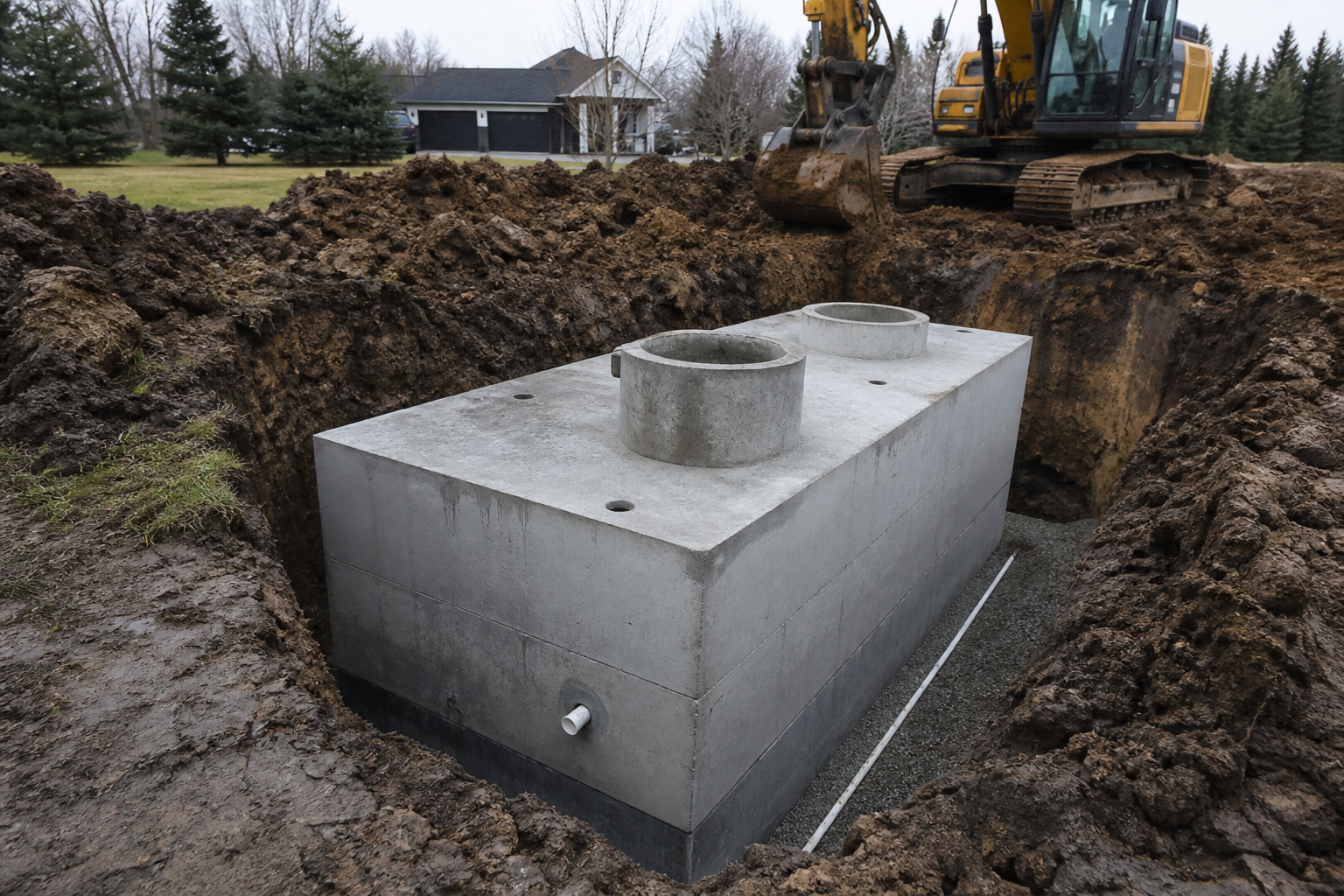
Cistern excavation
Cistern Excavation
Frost-depth holes in central Alberta clay. Tight acreage access. Clean spoil when we can.
Cistern excavation for Camrose, Leduc County, and Wetaskiwin. We dispatch licensed local pump technicians.
Request a call-back
Name and phone are required. Town and what is wrong help us dispatch the right truck.
No water right now? Do this first
- Check the breaker for the well or cistern pump once. Look, do not keep flipping it.
- Do not keep resetting a pump that trips. That cooks a motor and can hide a short.
- If the pump hums and will not start, shut pump power at the disconnect or breaker.
- Then call (587) 844-5333. We dispatch licensed local pump technicians in Camrose, Leduc County, and Wetaskiwin.
If pipes are silent after a cold night, treat it as a possible freeze. Do not torch a line in a crawlspace. See frozen water line thaw if ice is the likely cause.
The hole is the job
Cistern excavation is the dirt work under a cistern installation. Frost depth around here is often about 2 m, or 6-8 ft. A shallow set is how lids heave and lines freeze. We dig for winter, not for a pretty weekend.
Clay on Camrose-area parcels and on Leduc County acreages does not behave like sand. The hoe, the spoil pile, and the bedding all take time. Tight yards near a shop or a shelterbelt change the approach. We would rather tell you the access is ugly than pretend a compact machine can do a full-depth pit through a garden gate.
This is not cistern cleaning and it is not cistern pump repair. If the tank is staying, you do not need a new hole. If the tank is new, you need the dig and the install together.
We dispatch licensed local pump technicians in Camrose, Leduc County, and Wetaskiwin. Excavation is scheduled with the tank, not as a mystery extra on install day.
Ranges for a full cistern install, hole included, often run $5,000-$22,000. The hole is a large part of that when access is poor or frost is in.
How a pump call actually runs
Five steps. Diagnose, pull, size, install, document. We do not skip the cheap checks to sell a pump.
Diagnose
We test power, the pressure switch, tank air charge, and whether the pump is pulling water or just humming. Guesswork is how people buy a pump they did not need.
Pull
If the well pump or cistern pump has to come out, we pull it cleanly. Drop pipe, wiring, and pitless adapters stay documented so the next install is not a surprise.
Size
We size the replacement to the well yield, house demand, and lift - not the cheapest box on a shelf. A mismatched pump short-cycles or starves the house.
Install
Set the new pump, tank, or switch. Prime where needed. Confirm cut-in and cut-out. Leave the system holding pressure before we leave the yard.
Document
You get what we found, what we replaced, and the pressure settings. That record matters the next time a switch chatters or a cistern runs low.
Repair versus replace - the honest version
A lot of dead-pump calls are not a dead pump. The pressure tank bladder is gone. The pressure switch contacts are burned. A breaker is tripped and the motor is fine. Those parts cost less than a new submersible and a pull. We say so when that is the case.
If the pump is burned, sand-locked, or has already been patched once too often, we say that too. Typical well pump jobs run $1,500-$5,000. A cistern install often runs $5,000-$22,000 depending on tank size, access, and frost-depth excavation. Those are ranges, not a quote. The cheaper fix is the one that actually solves the failure.
Access, spoil, frost, and what we will not do
We mark utilities. We talk about where the spoil can sit. We talk about how the yard gets put back. None of that is a landscaping pitch. It is how you avoid a mountain of clay on the drive.
Hay Lakes and the Hwy 21 strip between Camrose and Wetaskiwin are almost all well or cistern. A new pit there is normal work. Millet, between Leduc and Wetaskiwin on Hwy 2A, is smaller lots mixed with acreages; access is the first question. Calmar, west of Hwy 2 on Hwy 39, is acreage country with longer lanes.
Diagnose still matters. An excavation booked to replace a tank that only needed a pump is a wasted hole. We check the existing system before the bucket hits dirt.
Frozen ground changes everything. A mid-winter emergency is usually a thaw or a pump, not a new pit. If your line is ice, go to frozen water line thaw. Do not ask for a hoe into frozen clay unless we have already said the tank is finished and there is no other water.
Document the depth, the bedding, and the lid elevation. The next person who opens that cistern should not guess. That is step five.
See also cistern installation, cistern cleaning, and frozen water line thaw. We do not take septic work or city-water plumbing.
No Ardrossan. No city-core plumbing. Rural water, county roads, licensed local pump technicians.
Form: Name, Phone, Town, What is wrong. Mention access, overhead lines, and whether the old tank is staying in the ground until the new one is set.
Questions homeowners ask
Why is there no water on the acreage?
A dead well pump, a tripped breaker, a failed pressure switch, a waterlogged pressure tank, an empty cistern, or a frozen line can all leave the house dry. Check the breaker once. Do not keep resetting it. Shut pump power if the motor hums and will not start. Then call so a licensed local pump technician can diagnose.
Why is the pressure tank cycling on and off?
Short cycling usually means a waterlogged pressure tank, a failed bladder, or a pressure switch that has drifted. That is often cheaper than a new pump. We test the tank air charge before we talk about pulling the well pump.
What is the difference between a cistern and a well?
A well pulls groundwater with a submersible or jet pump. A cistern stores hauled or collected water and uses its own pump to feed the house. Many acreages here run one or the other; some run both. Repair steps differ, so tell us which system you have.
What should I do if a water line is frozen?
Do not torch the line or keep resetting a pump against ice. Shut pump power if it is hammering a blocked line. A frozen water line thaw is its own job in an Alberta winter. Call and we dispatch licensed local pump technicians in Camrose, Leduc County, and Wetaskiwin.
Related services
Need a technician on the acreage?
We dispatch licensed local pump technicians in Camrose, Leduc County, and Wetaskiwin. Call now or send the short form.